
If you are thinking about renovating, extending, or building on your property, one of the first questions you may be tempted to ask is:
“How much will it cost?”
It sounds like the logical place to start.
But before asking a builder for a quote, there is a more important question:
What Are You Actually Trying to Achieve?
You may want more space for your family.
You may want to create rental income.
You may want to improve the value or usefulness of your property.
Or perhaps your circumstances are changing, and you simply want your home to work better for the next stage of your life.
These are very different objectives.
And the same property may offer very different ways of achieving them.
A Building Quote Only Prices One Option
Imagine you own a home with some unused space around it.
You might renovate the existing house, extend it, create an income-producing space, or consider whether doing nothing for now is actually the better option.
A builder may be able to tell you what an extension could cost.
But that quote does not tell you whether extending is the right option in the first place.
That is an important distinction.
A quote can help answer:
“What might this particular project cost?”
But it cannot, by itself, answer:
“Is this the right project for what I want to achieve?”
Compare the Options Before You Price the Solution
Before spending money on detailed plans, consultants or construction quotes, step back and compare the realistic options available to you.
For example, suppose your main objective is additional income.
An extension designed primarily to create more family living space may be technically possible — but it may not address the outcome you actually want.
A smaller conversion, a separate rental space, or another approach may deserve investigation first.
So the question is not simply:
“What can I build?”
It is:
“Which option is most likely to achieve what I want?”
Just because something can be done to a property does not mean it is the right thing to do.
Once You Have a Direction, Investigate What Matters
Choosing a preferred option does not mean you should immediately proceed.
It means you now have a clearer idea of what needs to be investigated before you commit.
What needs to be checked will depend on the property and the project.
For one property, the key questions might include:
Access — Is there suitable access for what you are considering?
Planning — Are there planning rules, development controls or approvals that could affect the idea?
Cost — What is a realistic cost once the project is clearly defined?
Income — If income is part of your objective, what could the completed space realistically produce?
Another project may require different information — perhaps design, servicing, engineering, valuation or finance.
You don’t need every answer at once.
You need the right answers for the decision in front of you.
Then Get the Right Quote
Once the direction is clearer and you know what needs to be investigated, the purpose of a building quote changes.
Instead of asking a builder to price a loosely defined idea, you can approach the quote with a much clearer project scope.
The sequence becomes:
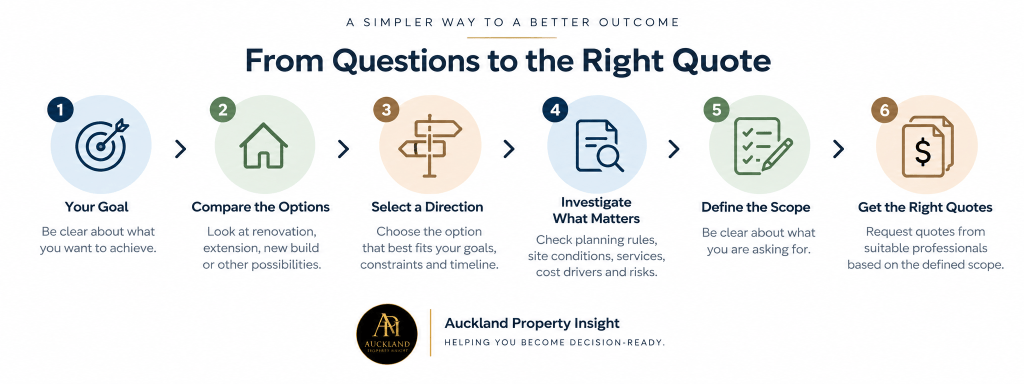
This can make your conversations with builders and other professionals much more useful.
It can also reduce the risk of spending time and money developing an option before you have established whether it deserves to proceed.
The Cheapest Option Is Not Necessarily the Best Decision
Comparing options does not simply mean finding the lowest construction cost.
One option may cost more but provide substantially more useful space or income.
Another may cost less but do little to help you achieve your longer-term objective.
And sometimes the better decision may be to do less — or not undertake the project at all.
The appropriate choice depends on what you are trying to achieve, the property itself, the evidence available, and how the project fits your wider circumstances.
That is why cost should be part of the decision — not the starting point for the decision.
Before You Ask “How Much?”, Ask One More Question
There is nothing wrong with getting building quotes.
The issue is when you get them — and what decision they are helping you make.
Before asking:
“How much will it cost?”
first ask yourself:
“Will this project actually give me the outcome I want?”
If the answer is not yet clear, it may be worth stepping back before commissioning detailed plans or collecting quotes.
First understand what you want the property to do.
Then compare the options.
Investigate what matters.
And only then get the right evidence and quotes for the decision in front of you.
Potential tells you what may be possible.
A good decision asks whether it makes sense for you.
Auckland Property Insight
Helping you become decision-ready.
Disclaimer: This article provides general property information and decision guidance only. It does not constitute planning, legal, financial, valuation, building or other professional advice. Property circumstances vary, and appropriate professional advice should be obtained before making project or financial commitments.
 The Property Decision Library
Leave a comment