
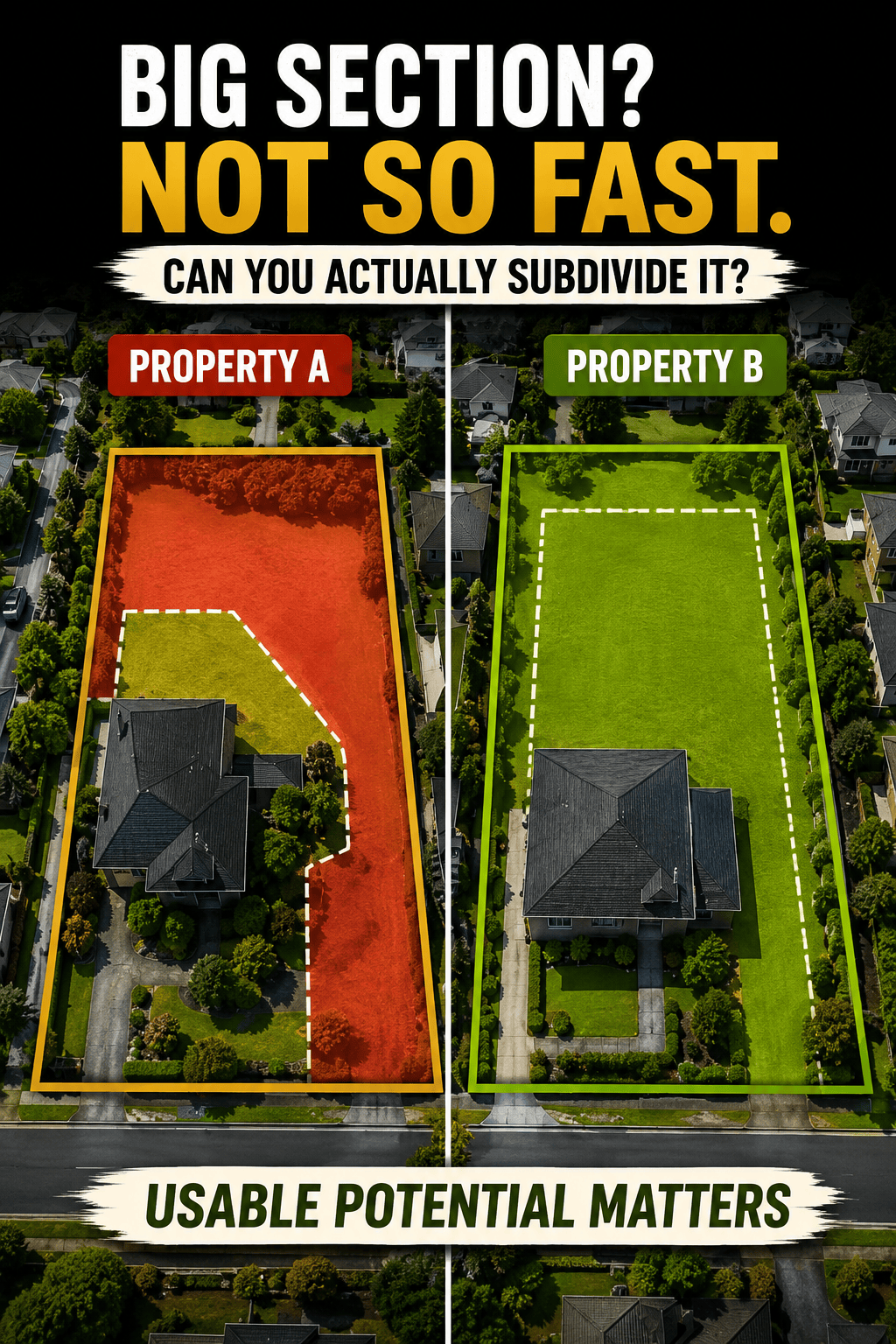
A large section can look full of possibility.
There may be an existing house at the front, plenty of lawn behind it, and enough space to imagine another home.
It is easy to look at that backyard and think:
“Surely this property can be subdivided.”
But section size is only the starting point.
The better question is:
What can this particular site actually support?
A Big Section Can Be Deceptive
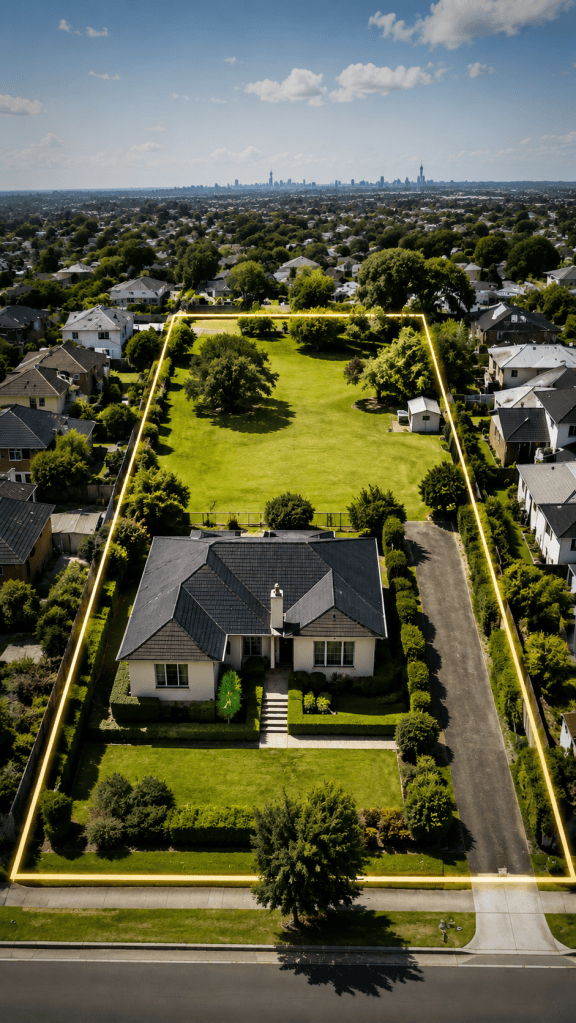
When we first look at a property, land size is one of the easiest things to understand.
A large backyard immediately creates possibilities in our minds — another dwelling, subdivision, an extension, or perhaps a future development opportunity.
And land area does matter.
But the number of square metres on a property record does not, by itself, tell us how much of that land can practically support the development we have in mind.
A big section is where the investigation begins — not where it ends.
What We See vs What the Site Can Support
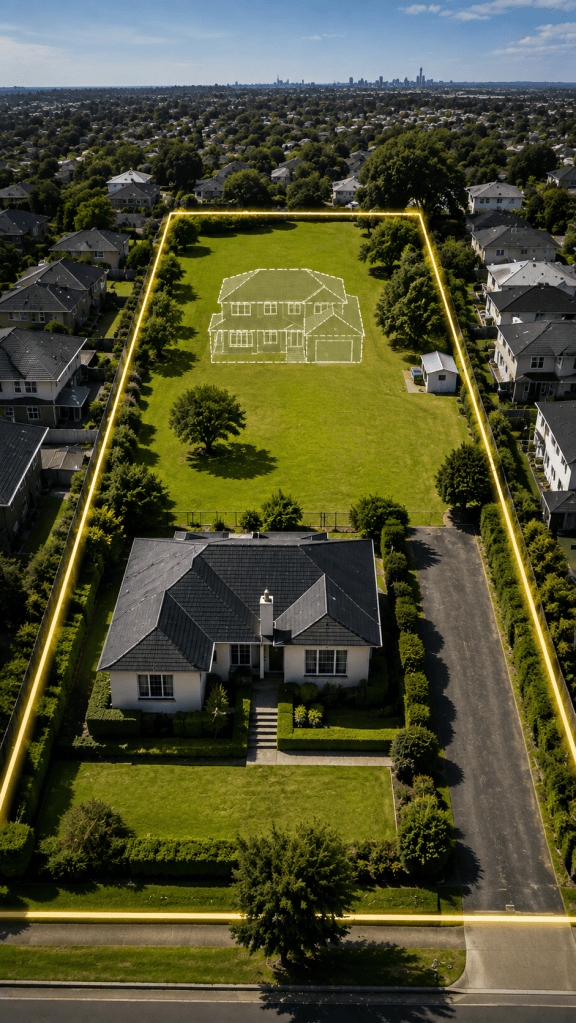
An open backyard makes it easy to mentally place another house on the land.
From above, it may even look obvious:
Existing house here. New house there.
But a proposed dwelling cannot be considered in isolation.
Before assuming that the apparent empty space represents development potential, we need to understand what else is happening across the site.
That is where the picture can start to change.
Four Things the Backyard Doesn’t Immediately Tell You
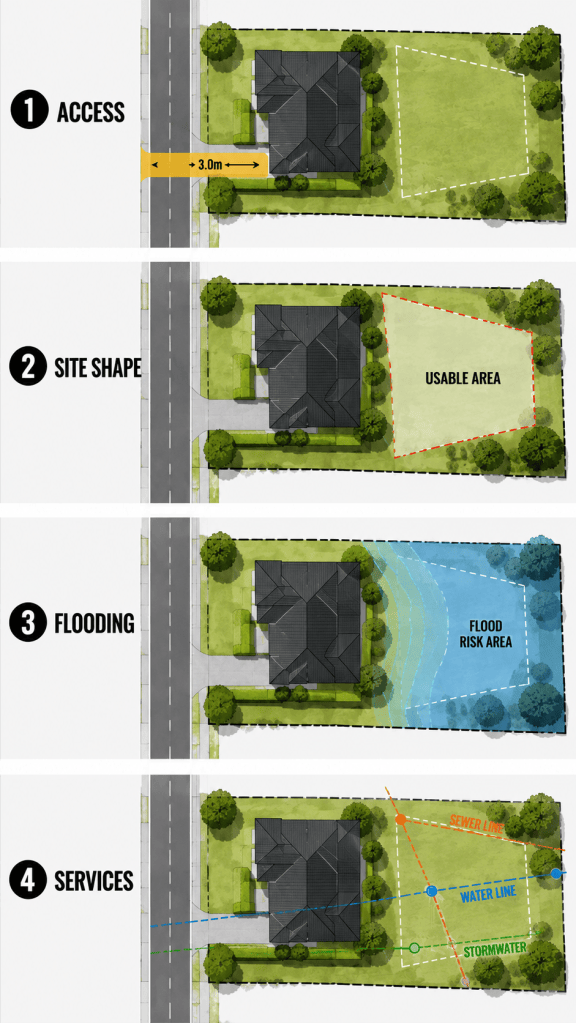
The Short simplifies the initial investigation into four practical questions.
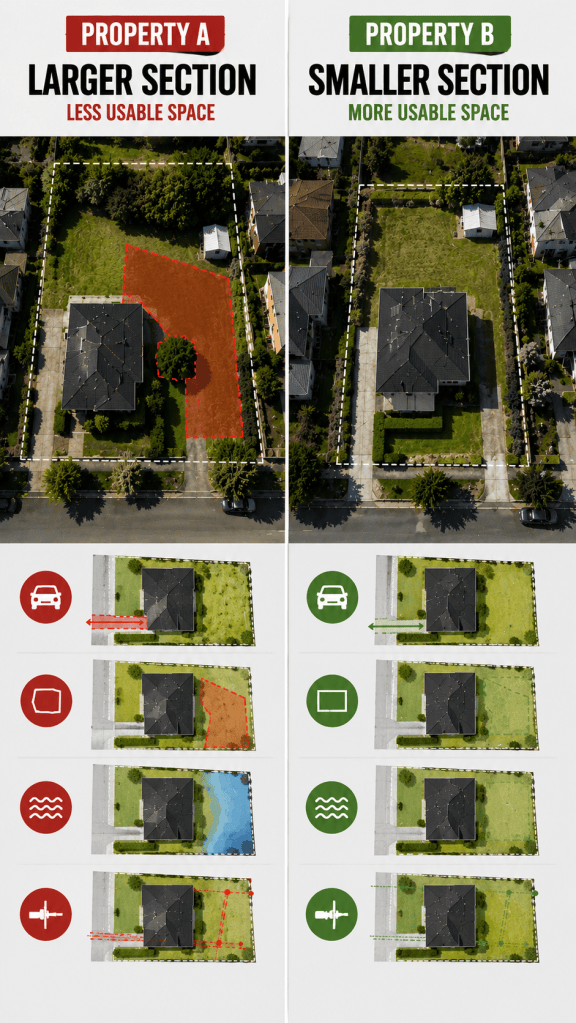
1. Access
There may be plenty of land behind the house — but how will another dwelling be accessed?
The existing house position, driveway configuration and connection to the road can materially affect the practical options for a site.
2. Site Shape
Two properties with the same land area can behave very differently.
A long, narrow or irregular section may leave considerably less useful development space than its total area suggests.
The position of the existing house can make an equally important difference.
3. Flooding
Part of an apparently open backyard may be affected by flooding, an overland flow path or another natural-hazard consideration.
That doesn’t automatically mean development is impossible.
It means the issue needs to be understood before treating all of the visible land as usable development space.
A constraint is something to investigate — not automatically a deal-breaker.
4. Services
Then there are things you may not see at all.
Wastewater, stormwater, water and other infrastructure can affect where and how development might occur.
Existing pipes, connection options and engineering requirements can all influence what is practical.
Key point
What you can see is the land.
What you need to understand is the site.
Now Compare Two Properties
Imagine Property A has the larger section.
At first glance, it seems like the obvious development opportunity.
There is more land and a bigger backyard.
But once access, the position of the existing house, site configuration, flooding and services are considered, the genuinely usable area may become much smaller.
Now look at Property B.
Its total section may be smaller, but perhaps the existing house is better positioned, access is clearer and the remaining land is configured more efficiently.
Suddenly, the smaller property may offer the more practical opportunity.
That gives us an important property decision principle:
LARGER SITE ≠ MORE POTENTIAL
Compare Usable Potential — Not Just Land Area
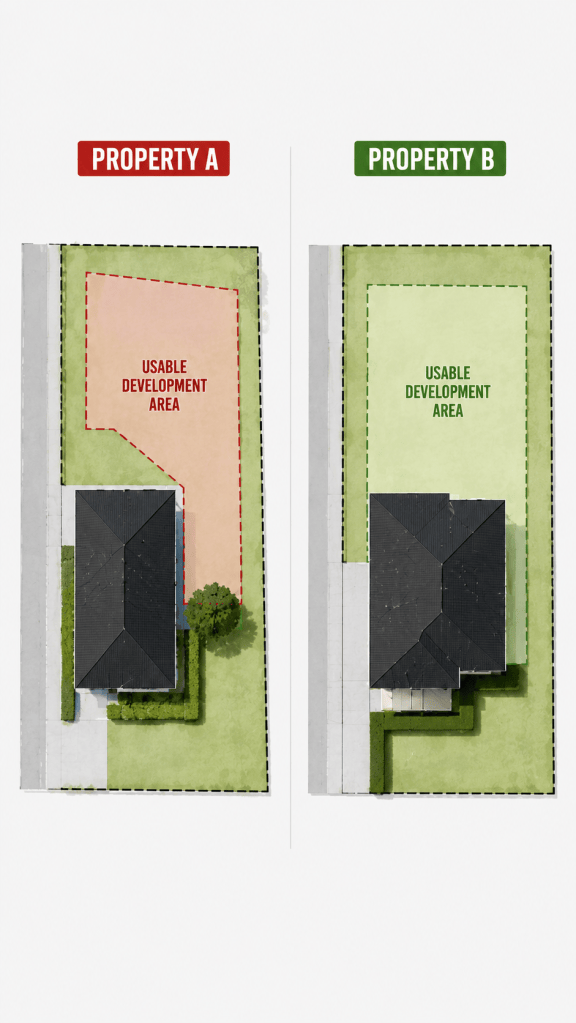
Once the visual clutter is removed, the difference becomes easier to understand.
Property A may have more land overall.
Property B may have more land that is useful for the particular development being considered.
Those are not the same thing.
This is why buyers should be careful when they see property marketing phrases such as:
“Large section.”
“Development potential.”
“Potential to subdivide.”
Those descriptions can identify something worth investigating, but they should not make the decision for you.
Before paying a premium for perceived development potential, ask:
What development outcome am I actually trying to achieve — and can this particular site realistically support it?
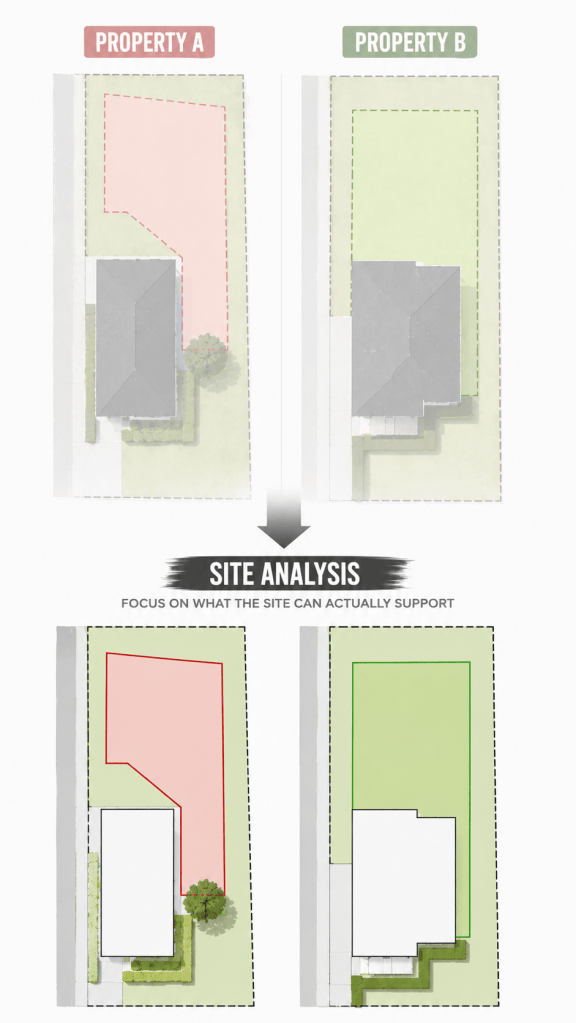
Start With the Decision, Not the Backyard
When you visit a property, you can see the house.
You can see the backyard.
You can see the approximate amount of land.
But development potential requires another layer of investigation.
Planning controls.
Access.
Site configuration.
Natural hazards.
Infrastructure.
Feasibility.
And importantly, apparent potential is not the same as confirmed subdivision or development approval.
Property-specific feasibility should be checked against the applicable planning requirements and, where appropriate, verified with suitably qualified planning, surveying, engineering and other professionals.
A large section is something you can see.
Development potential is something you have to understand.
Don’t judge by size alone.
Understand what the site can actually support.
Auckland Property Insight
Helping you become decision-ready.
Disclaimer
This article provides general property decision-making information only. It is not planning, engineering, surveying, legal, financial or other professional advice. Subdivision and development feasibility is property-specific and should be verified through the relevant planning requirements, property information and appropriately qualified professionals before making a property or development decision.
 The Property Decision Library
Leave a comment